

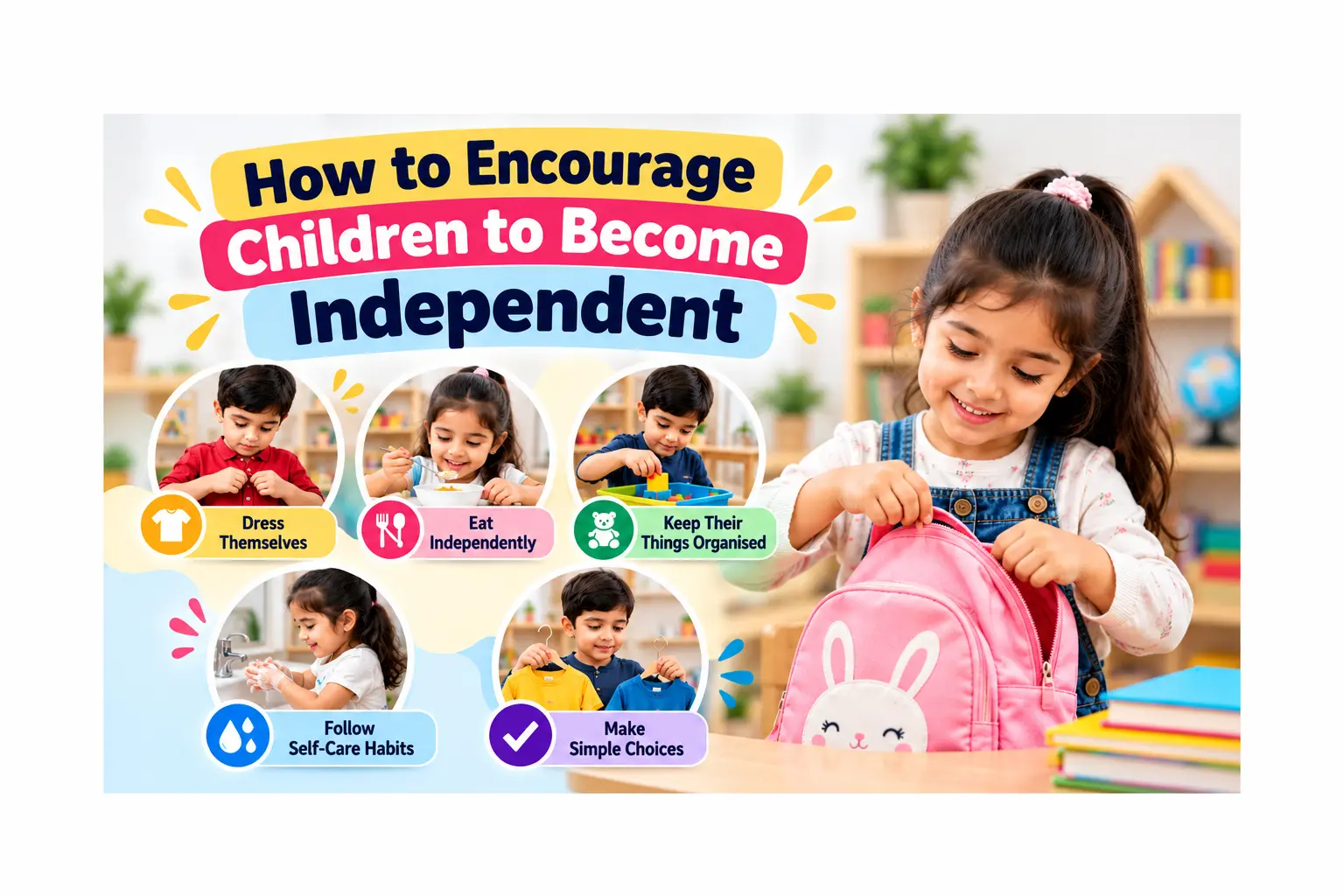
Every parent wants their child to grow up confident, responsible and capable of handling daily tasks. But children do not become independent in one day. They learn these skills slowly through practice, guidance and everyday experiences.
Some children learn to dress themselves at an early age, while others need more time. Some children feel comfortable talking to new people, while others may feel shy. Every child is different, and parents should give them time to learn at their own pace.
Encouraging independence in children means teaching them to do simple things on their own while giving them love, support and guidance.
In this blog, we will share simple ways parents can help children become more independent at home and in preschool.
What Does Independence Mean for Children?
Independence means helping children learn to do age-appropriate tasks without always depending on adults.
For young children, independence can include:
Putting toys back after playing
Eating with a spoon
Washing their hands
Choosing a book to read
Wearing their shoes
Keeping their school bag in the right place
Asking for help when needed
Making simple choices
These small activities may look simple, but they help children develop confidence and responsibility.
Why Is Independence Important in Early Childhood?
The early years are an important time for learning new skills. When children get opportunities to try things on their own, they learn more about themselves and the world around them.
Here are some benefits of encouraging independence in children.
1. Builds Confidence
When a child completes a task without help, they feel proud of their effort.
For example, when a child puts on their shoes alone, they may feel happy and ready to try another task.
Parents can encourage this feeling by saying, "You tried it yourself. Well done!"
2. Develops Problem-Solving Skills
Children may face small problems while playing or completing daily tasks.
Instead of solving every problem for them, parents can give them time to think.
For example, if a child cannot fit a puzzle piece, ask, "Can you try turning it around?"
This helps children learn to think and try different solutions.
3. Teaches Responsibility
Children can learn to take care of their belongings from an early age.
They can put toys away, place books on a shelf and keep their shoes in the correct place.
These simple habits help children understand that they have responsibilities too.
4. Improves Decision-Making
Allowing children to make small choices helps them understand their likes and needs.
Parents can ask, "Would you like the red shirt or the blue shirt?"
The child gets to make a choice while the parent keeps the options suitable.
5. Supports Social Development
Independent children get opportunities to speak, share their ideas, ask questions and solve small problems with others.
These skills can help them feel more comfortable in preschool, kindergarten and other social settings.
10 Simple Ways to Encourage Children to Become Independent
1. Let Children Do Small Tasks Themselves
One of the easiest ways to encourage independence is to allow children to do simple daily tasks.
Depending on their age, children can:
Pick up their toys
Put dirty clothes in a basket
Carry their own water bottle
Put books back on a shelf
Help arrange the dining table with safe items
At first, children may take more time or make mistakes. That is normal.
Give them enough time to practise instead of doing everything for them.
2. Teach Children to Dress Themselves
Getting dressed is a useful daily activity for young children.
Start with simple tasks, such as putting on a loose T-shirt, wearing shoes or pulling up trousers.
Choose clothes that are easy for your child to handle.
You can first show your child how to do the task and then let them try.
Do not worry if they need several attempts. Regular practice can help them improve.
3. Encourage Independent Eating
Mealtimes are a good opportunity to develop independence.
Give children age-appropriate spoons and safe dishes. Allow them to try eating by themselves when they are ready.
They may spill food or make a mess at first. Stay patient and show them how to use their spoon.
Always supervise young children while eating and provide food that is suitable for their age to reduce choking risks.
4. Allow Children to Make Simple Choices
Children feel more involved when they can make small decisions.
You can ask:
Which story would you like to read?
Would you like to play with blocks or puzzles?
Which colour would you like to use?
Would you like to wear these shoes or those shoes?
Keep the choices simple and suitable for the situation.
This helps children practise decision-making without feeling confused by too many options.
5. Teach Children to Keep Their Things Organised
Children can learn to look after their belongings with a little help.
Create a fixed place for toys, books, shoes and school bags.
Use low shelves or labelled baskets so children can easily find and return their things.
Make cleaning up part of the daily routine. For example, ask your child to put the blocks back in the basket before moving to another activity.
6. Give Children Time to Solve Small Problems
Parents often want to help immediately when a child struggles. However, children also need time to try.
If your child is building a tower and it falls, do not rebuild it straight away.
Ask, "What could we do to make it stronger?"
If your child cannot find a toy, help them think about where they last played.
Offer guidance when needed, but allow them to make an effort first.
7. Teach Basic Self-Care Habits
Self-care habits help children manage everyday needs.
Parents can teach children to:
Wash their hands
Brush their teeth with age-appropriate supervision
Use a tissue
Keep their face clean
Put away their shoes
Follow a simple morning routine
Show each task step by step. Younger children may need reminders and supervision for a long time.
The aim is to help them learn gradually, not to expect them to do everything perfectly.
8. Encourage Children to Ask for Help
Being independent does not mean doing everything alone.
Children should understand when they can try something themselves and when they need an adult's help.
Teach them to say:
"Can you please help me?"
"I don't understand."
"I cannot reach this."
"Can you show me how to do it?"
This helps children become confident while knowing that support is available when they need it.
9. Praise Effort, Not Just Results
Children need encouragement while learning new skills.
Instead of saying only "You are so clever," notice the effort they made.
You can say:
"You kept trying."
"You put all your toys away."
"You tried a new way."
"You did that step by yourself."
This helps children understand that learning takes practice and mistakes are part of the process.
Avoid comparing your child with siblings, friends or classmates. Every child develops at a different pace.
10. Be Patient and Give Children Time
Independence takes time to develop.
A child may be able to put on shoes one day but ask for help the next day. This is normal, especially when they are tired, upset or in a hurry.
Try not to scold children for making mistakes while learning.
Give clear instructions, demonstrate the task and allow them to try again.
Patience and regular practice are more helpful than pressure.
How Montessori Education Encourages Independence
Montessori education gives children opportunities to learn through hands-on activities and everyday tasks.
In a Montessori classroom, children may practise pouring, sorting, arranging materials, completing puzzles and returning items to their proper places.
These activities help children practise concentration, coordination and responsibility.
Teachers guide children and show them how to use materials safely. Children then get opportunities to repeat activities and improve their skills.
For parents exploring a Montessori school in Patiala, it is useful to ask how the school encourages children to complete age-appropriate tasks, make simple choices and take care of classroom materials.
At home, parents can use similar ideas by giving children safe, simple tasks and allowing them to practise at their own pace.
Common Mistakes Parents Should Avoid
While encouraging independence, parents should avoid these common mistakes.
Doing everything for the child: Children need opportunities to practise daily tasks.
Expecting too much too soon: Tasks should match the child's age and abilities.
Scolding children for mistakes: Mistakes are a normal part of learning.
Comparing children: Every child develops differently.
Giving too many instructions: Simple, clear directions are easier for young children to follow.
Leaving children without support: Independence should always come with age-appropriate supervision and safety.
Final Thoughts
Helping children become independent is a gradual process. It begins with small daily activities, such as putting away toys, choosing clothes, washing hands and helping with simple tasks.
Parents do not need to teach everything at once. Choose one or two activities and allow your child to practise them regularly.
Remember to be patient, offer encouragement and let your child try before stepping in to help.
When children get the chance to practise, make choices and learn from mistakes, they can gradually become more confident, responsible and independent.
Frequently Asked Questions (FAQs)
1. How can I encourage my child to become independent?
Start with simple daily tasks, such as putting away toys, wearing shoes and washing hands. Show your child how to do each task and give them time to practise.
2. At what age should children start learning independence?
Children can begin learning simple skills during toddlerhood. The tasks should match their age and abilities. Parents should guide and supervise them as needed.
3. Why is independence important for preschool children?
Independence helps preschool children practise confidence, responsibility, decision-making and problem-solving. It also prepares them for everyday routines at home and school.
4. How can Montessori education help children become independent?
Montessori education gives children opportunities to practise hands-on activities, care for learning materials and complete simple tasks. Teachers guide children while allowing them to try activities themselves.
5. Should parents help children with every task?
No. Parents should help when needed, but children should also get chances to try age-appropriate tasks on their own. A balance of guidance and practice supports learning.
6. What activities help develop independence in young children?
Activities such as sorting toys, pouring water with supervision, dressing, arranging books, completing puzzles and cleaning up after play can help children practise independence.
7. How can I teach my child to make decisions?
Offer two or three suitable choices, such as selecting a book or choosing between two outfits. Allow your child to make a choice within safe and reasonable limits.
8. What should I do if my child refuses to do things independently?
Stay calm and try to understand why. The task may feel difficult, or your child may be tired. Break the task into smaller steps, demonstrate it and encourage another attempt.
9. How can parents build confidence in children?
Praise effort, allow children to try new tasks, listen to their ideas and avoid comparing them with others. Help them learn from mistakes without fear of being scolded.
10. Does independence mean children should never ask for help?
No. Independence also means knowing when help is needed. Children should feel comfortable asking a trusted adult for guidance or support.
11. How can parents encourage independence at home?
Create simple routines, keep children's belongings within reach and give them small responsibilities. Regular practice can help children learn to manage everyday tasks.
12. How long does it take for a child to become independent?
There is no fixed timeline. Children develop different skills at different ages. Regular practice, patience and support can help them gradually become more independent.