

Papa, mobile do!
Mummy, please give me the phone!
If your child asks for a mobile phone many times a day, you are not alone. Many parents find it difficult to manage screen time, especially when a child starts crying or having a tantrum after the phone is taken away.
Mobile phones can be useful. Children can watch educational videos, listen to stories, or use 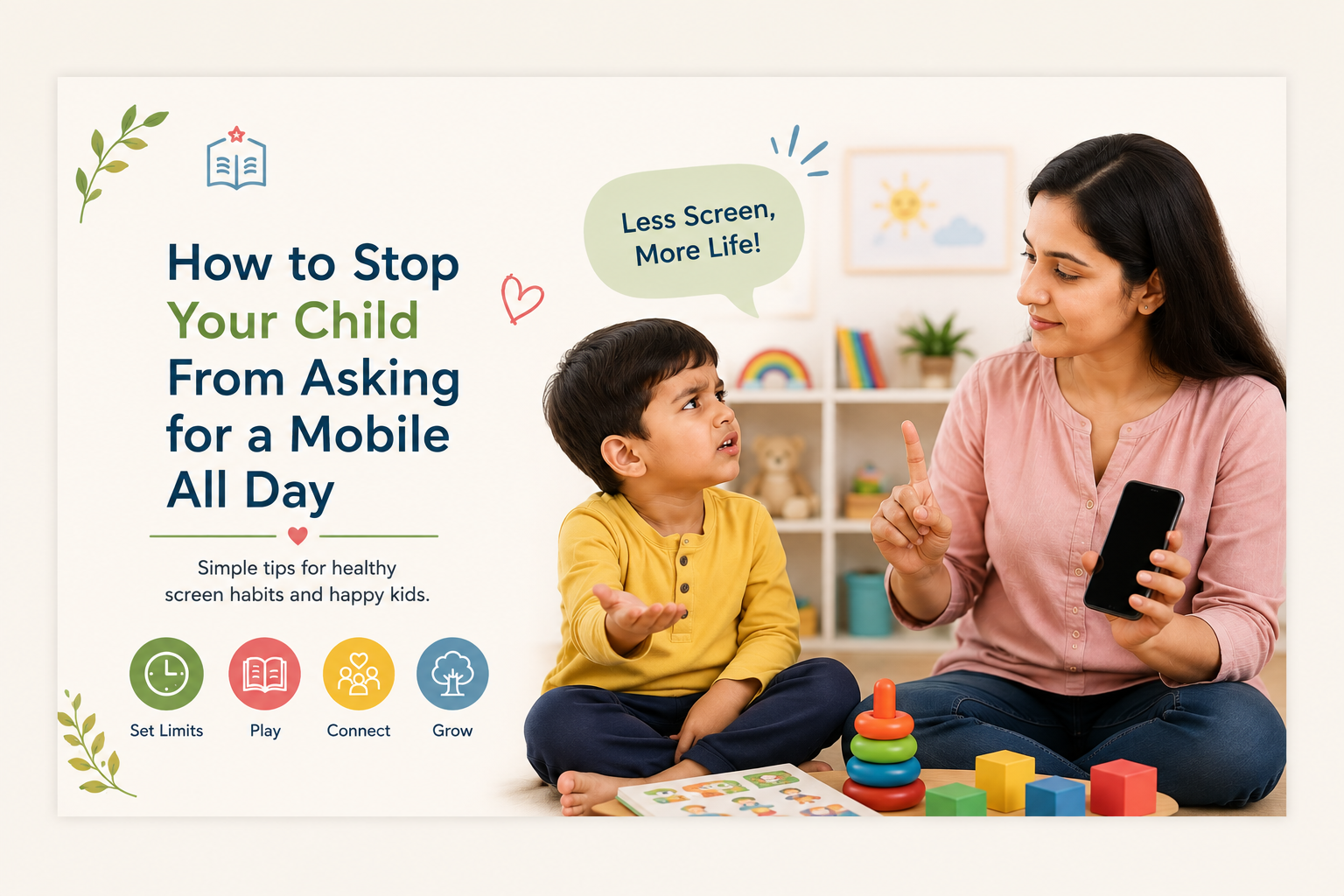 learning apps. But when a child starts asking for a mobile all day, it may be time to create healthier screen habits.
For preschool children, real-world activities are very important. Talking with parents, playing with other children, drawing, building, running, reading, and exploring help children learn in different ways.
The good news is that parents do not need to take the mobile away suddenly. Small changes, clear rules, and interesting alternatives can help children slowly reduce screen time.
At BIPS Preschool, we believe young children learn best when they get opportunities to play, explore, communicate, and learn through real experiences.
Why Does My Child Ask for a Mobile All the Time?
Before changing the habit, it helps to understand why children want the phone so often.
Mobile Phones Are Very Interesting
Phones have bright colours, sounds, videos, games, and quick entertainment. Children can move from one video to another very easily.
Compared with a simple toy or book, a mobile phone can provide constant new things to watch.
This is one reason why children may find it difficult to stop using screens.
Children May Be Bored
Sometimes children ask for a mobile simply because they do not know what else to do.
They may say:
- "I'm bored."
- "There is nothing to do."
- "Give me the phone."
This does not always mean they need a phone. They may simply need ideas for another activity.
Parents May Use the Phone to Keep Children Busy
Parents are busy too. Sometimes giving a phone is an easy way to keep a child quiet while cooking, working, travelling, or completing household tasks.
There is nothing wrong with needing a short break. The problem can come when the phone becomes the child's main source of entertainment.
How to Reduce Screen Time Without Daily Fights
Reducing screen time works better when parents make a simple plan instead of suddenly removing the phone.
1. Set Clear Screen Time Rules
Children need to know when they can and cannot use the phone.
For example:
"You can watch your favourite programme after your evening snack for a short time."
Try to keep the rule simple.
Avoid changing the rule every day because children may become confused and continue asking.
2. Do Not Give the Phone Every Time Your Child Asks
If a child asks for the phone and receives it every time, they quickly learn that asking works.
Instead, calmly say:
"Mobile time is finished. You can choose a book or play with your blocks."
Your child may complain at first. Stay calm and repeat the rule.
The goal is to teach your child that asking again and again will not change the answer.
3. Give a Warning Before Screen Time Ends
Stopping a favourite activity suddenly can be difficult for young children.
Give a warning before switching off the screen.
You can say:
"Ten more minutes, then we will put the phone away."
Later, say:
"Two more minutes, and then mobile time is finished."
This gives your child time to prepare for the change.
4. Replace Screen Time With Fun Activities
This is one of the most important steps.
Do not simply remove the mobile. Give your child something interesting to do instead.
Try These Screen-Free Activities:
- Drawing and colouring
- Building blocks
- Puzzles
- Picture books
- Storytelling
- Clay activities
- Singing and dancing
- Playing with toys
- Water play
- Gardening
- Simple cooking activities
- Outdoor games
- Cycling
- Ball games
- Pretend play
The activity does not have to be expensive. Children often enjoy simple things when adults give them time and attention.
5. Create a Daily Routine
A daily routine can make screen time easier to manage.
For example:
Morning: Breakfast → Get ready → Preschool
Afternoon: Lunch → Rest → Drawing or free play
Evening: Outdoor play → Family time → Limited screen time
Night: Dinner → Storytime → Sleep
When children know what happens next, they may ask for the mobile less often.
6. Keep Phones Away During Meals
Family meals are a good opportunity for children to talk.
Make the dining table a screen-free place.
Instead of watching a video while eating, talk about the day.
Ask simple questions:
- "What did you do today?"
- "Who did you play with?"
- "What was your favourite activity?"
- "What would you like to do tomorrow?"
These conversations support communication and language development.
7. Avoid Using the Mobile Before Bedtime
Screen use close to bedtime can become part of a child's sleep routine.
Instead, create a calm bedtime routine.
You can try:
Bath → Pajamas → Story → Talking → Sleep
Reading a short story every night can also encourage children to enjoy books instead of screens.
8. Parents Should Follow the Same Rules
Children learn by watching adults.
If parents are constantly checking their phones, children may naturally want to do the same.
Try creating family screen-free periods.
For example:
- No phones during meals
- No phones during family conversations
- No phones during outdoor play
- Phones away during bedtime routines
When parents follow the rules too, children are more likely to accept them.
What If Your Child Has a Tantrum?
A tantrum may happen when screen time is reduced.
Try not to panic.
Stay calm and acknowledge your child's feelings.
You can say:
"I know you want to watch more. You are upset because mobile time is finished. We can play with your blocks now."
Do not shout or give a long lecture.
If you give the mobile back every time your child cries, your child may learn that crying brings the phone back.
Be kind, but remain consistent.
Encourage Boredom and Independent Play
Parents sometimes feel they must keep children entertained all the time.
They do not.
A little boredom can encourage children to use their imagination.
Give your child a safe space with a few simple toys and allow them to decide what to play.
They might build a house with blocks, create a pretend shop, draw a picture, or make up a story.
These activities support creative thinking, problem-solving, independence, and imagination.
How Preschool Can Help Reduce Mobile Dependence
A good preschool gives children many opportunities to learn without screens.
At BIPS Preschool, children can take part in activities that encourage communication, movement, creativity, social interaction, and hands-on learning.
These can include:
- Storytelling
- Art and craft
- Music and movement
- Puzzles
- Practical activities
- Group games
- Outdoor play
- Role play
- Hands-on learning
Children learn that fun does not always come from a digital device.
This is one reason parents looking for a preschool in Patiala should consider the school's overall learning environment and approach to child development.
How Montessori Learning Supports Healthy Habits
Parents exploring a Montessori school in Patiala may be interested in hands-on learning.
Montessori-inspired activities allow children to touch, move, sort, build, match, and explore.
Instead of watching a screen demonstrate something, children can learn by doing it themselves.
This can support:
- Concentration
- Independence
- Fine motor skills
- Problem-solving
- Confidence
- Practical life skills
A balanced early education gives children many reasons to stay curious without depending on a mobile phone.
Do Not Expect the Habit to Change Overnight
If your child has been using a mobile for several hours every day, the habit may not disappear in one or two days.
Be patient.
You may notice:
First: More requests for the phone.
Then: Some arguments or boredom.
Later: Interest in other activities.
Eventually: Better acceptance of the routine.
Every child is different. Focus on progress instead of perfection.
When Should Parents Be More Concerned?
Parents should pay attention if screen use is regularly interfering with important parts of daily life, such as sleep, meals, physical activity, school participation, family interaction, or social play.
If you have concerns about your child's behaviour, development, sleep, speech, or emotional wellbeing, discuss them with a qualified child-development or healthcare professional.
FAQs
Why does my child ask for a mobile all day?
Children may ask for a mobile because it is entertaining, they are bored, or they have become used to using screens frequently. A predictable routine and interesting alternatives can help.
How can I reduce my child's screen time?
Set clear limits, give warnings before screen time ends, create screen-free periods, and replace mobile use with play, books, outdoor activities, creative work, and family interaction.
Should I completely stop giving my preschool child a mobile?
Not necessarily. The goal is to develop healthy screen habits and make sure screens do not replace sleep, physical activity, family interaction, learning, or play.
What should I do if my child cries when I take the phone away?
Stay calm, acknowledge the child's feelings, and maintain the agreed limit. Offer another activity instead of immediately giving the phone back.
What are good screen-free activities for preschool children?
Storytelling, drawing, colouring, puzzles, blocks, pretend play, music, dancing, outdoor games, books, and simple household activities are good options.
Can preschool help children spend less time on screens?
Yes. A good preschool provides children with social interaction, hands-on learning, creative activities, movement, storytelling, and play, giving them enjoyable alternatives to screens.
Is Montessori education helpful for reducing screen dependence?
Montessori-inspired learning focuses on hands-on activities, practical life skills, concentration, independence, and exploration. These experiences can give children meaningful alternatives to screen entertainment.
How can parents become good role models for healthy screen habits?
Parents can put their phones away during meals, conversations, playtime, and bedtime routines. Children often copy what they see adults doing.
What is the best preschool in Patiala for overall child development?
Parents should look for a preschool that provides a safe environment, caring teachers, age-appropriate learning, social interaction, creative activities, and opportunities for physical and hands-on learning. BIPS Preschool focuses on these areas as part of its early childhood learning environment.
Conclusion
A child asking for a mobile phone all day can be frustrating, but it is a habit that can be changed with patience and consistency.
The answer is not simply to take the phone away. Children need something positive to replace it. Storybooks, outdoor play, drawing, puzzles, building blocks, music, pretend play, and family conversations can make a big difference.
Start with small changes. Set simple rules, follow a daily routine, give your child choices, and try to keep phones away during important family moments.
Most importantly, remember that young children learn through real experiences. They need opportunities to talk, move, explore, create, make friends, and solve simple problems.
At BIPS Preschool, we encourage children to learn through meaningful, hands-on experiences that support communication, confidence, creativity, independence, and healthy development.