

Montessori education has produced some of the world's most original thinkers. Here is why — and what it means for your child.
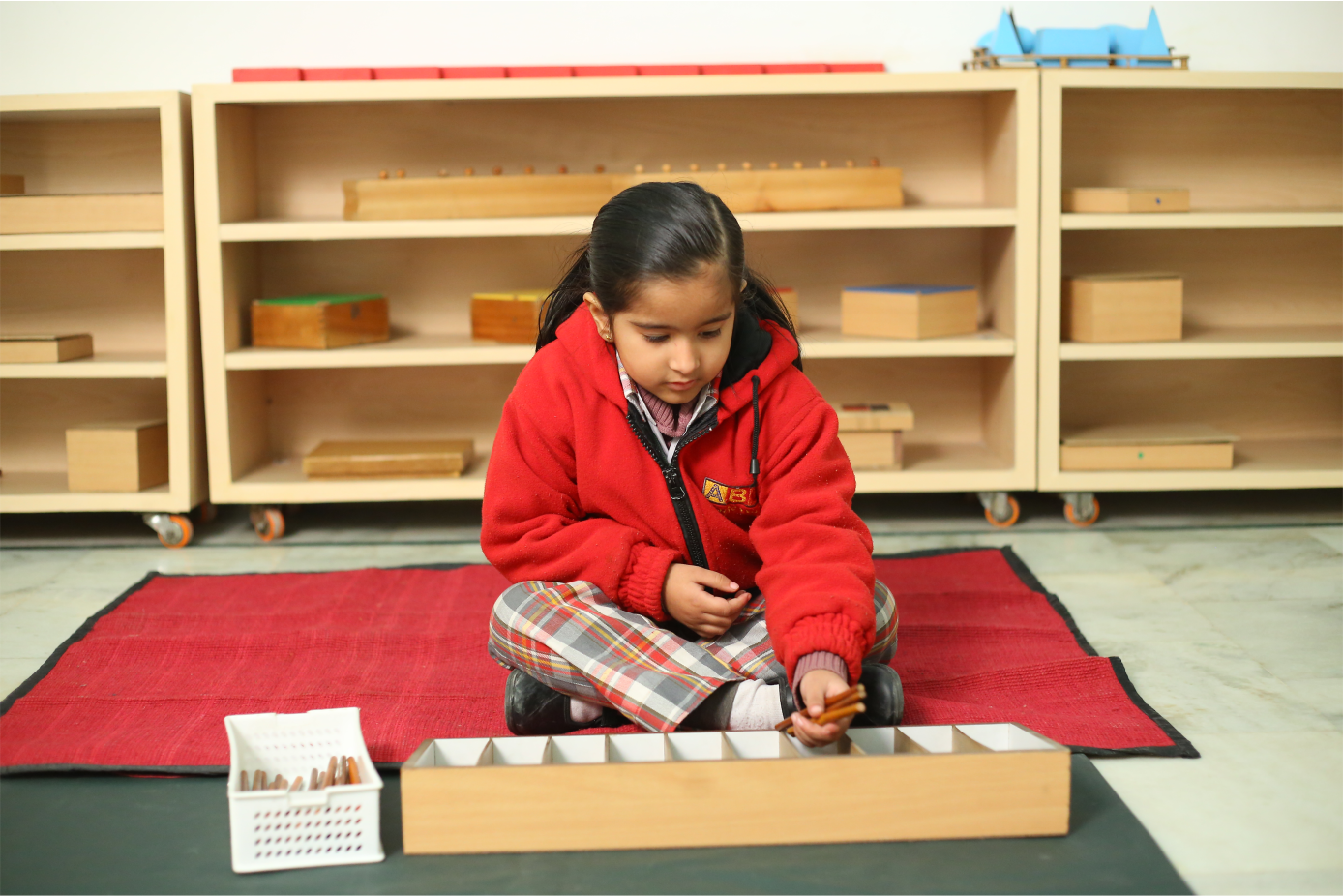
There is a classroom in Patiala where a four-year-old is quietly sorting wooden cylinders by size, completely absorbed, without being told to sit still or pay attention. Across the room, a five-year-old is tracing sandpaper letters with her fingertips, connecting the shape of a letter to its sound through touch. A six-year-old is working through multiplication using a set of golden beads, physically moving objects to understand what the numbers mean.
Nobody failed this morning. Nobody was scolded for being behind. Nobody was bored by being held back.
This is a Montessori classroom — and it operates on a set of principles so different from conventional schooling that it can feel almost counterintuitive until you understand the science behind it.
Maria Montessori Was a Scientist First
Dr. Maria Montessori did not arrive at her educational method through philosophy alone. She was a physician and scientist who spent years observing children in controlled environments, carefully documenting what conditions produced the deepest engagement, the most genuine learning, and the most joyful development.
Her central finding was simple and radical: children are natural learners. When placed in an environment that respects their developmental stage, provides the right materials, and allows them to move at their own pace, children will teach themselves — with a depth of understanding and a degree of intrinsic motivation that direct instruction rarely achieves.
This insight has been validated repeatedly by modern neuroscience. The prefrontal cortex — the part of the brain responsible for decision-making, focus, and executive function — develops most rapidly between the ages of two and six. The experiences a child has during this window shape the neural pathways that will govern their thinking for the rest of their lives. An environment that stimulates curiosity and rewards independent exploration during these years creates a fundamentally different brain from one that rewards compliance and memorisation.
Why 'Montessori' Is Not Just a Marketing Word
One important caution for parents: the word 'Montessori' is not trademarked and has no legal protection. Many schools attach it to their name without implementing its principles. Authentic Montessori requires specifically trained educators who understand child development at a deep level, scientifically designed Montessori materials developed through decades of refinement, carefully prepared classroom environments where every object has a developmental purpose, and a pedagogical culture that genuinely allows children to choose their activities and work at their own pace.
Bhupindra International Public School is widely known as the only authentic Montessori school in Patiala. This is not a marketing claim. It is reflected in the observable outcomes of its students.
What Montessori Children Are Actually Capable Of
Parents who encounter BIPS Montessori students for the first time are often surprised. A six-year-old who can comfortably perform mathematical calculations involving numbers up to ten thousand. A five-year-old who speaks with confidence on stage in front of the entire school. Children who communicate in four or five languages with natural ease. Not because they were drilled or pushed, but because the environment they grew up in made these achievements feel natural and joyful.
The long-term research on Montessori outcomes is equally striking. Studies tracking Montessori students into adolescence and adulthood find consistently stronger executive function, greater creative problem-solving ability, higher intrinsic motivation, and stronger social skills compared to traditionally educated peers. The Montessori alumni include Jeff Bezos, Larry Page, Sergey Brin, and Elon Musk — not because Montessori guarantees exceptional outcomes, but because it develops the specific cognitive qualities that exceptional outcomes require: independence, deep curiosity, the ability to focus, and the confidence to pursue original ideas.
Montessori Into CBSE: Why the Transition Works
A common parental concern is whether Montessori's open, self-directed approach can produce students capable of succeeding in the structured demands of CBSE board examinations. The answer is yes — and the reason is instructive.
Montessori does not produce undisciplined learners. It produces self-disciplined learners — children who have developed the ability to focus deeply because they genuinely want to understand something, not because an authority figure is watching them. When these children encounter the structured academic demands of secondary school, they bring with them strong conceptual foundations, high intrinsic motivation, and the intellectual confidence to handle complex material.
BIPS graduates consistently appear among the district and state toppers in CBSE board examinations. The Montessori foundation does not contradict academic excellence. It creates the conditions for it.
"The goal of early education is not to fill a child with information. It is to ignite a love of discovery that will drive them for the rest of their lives."
The early years of your child's life will never come again. The thinking patterns, learning attitudes, and self-belief formed between ages two and six are extraordinarily difficult to change later. Choose those years — and the environment that shapes them — with the care they deserve.