

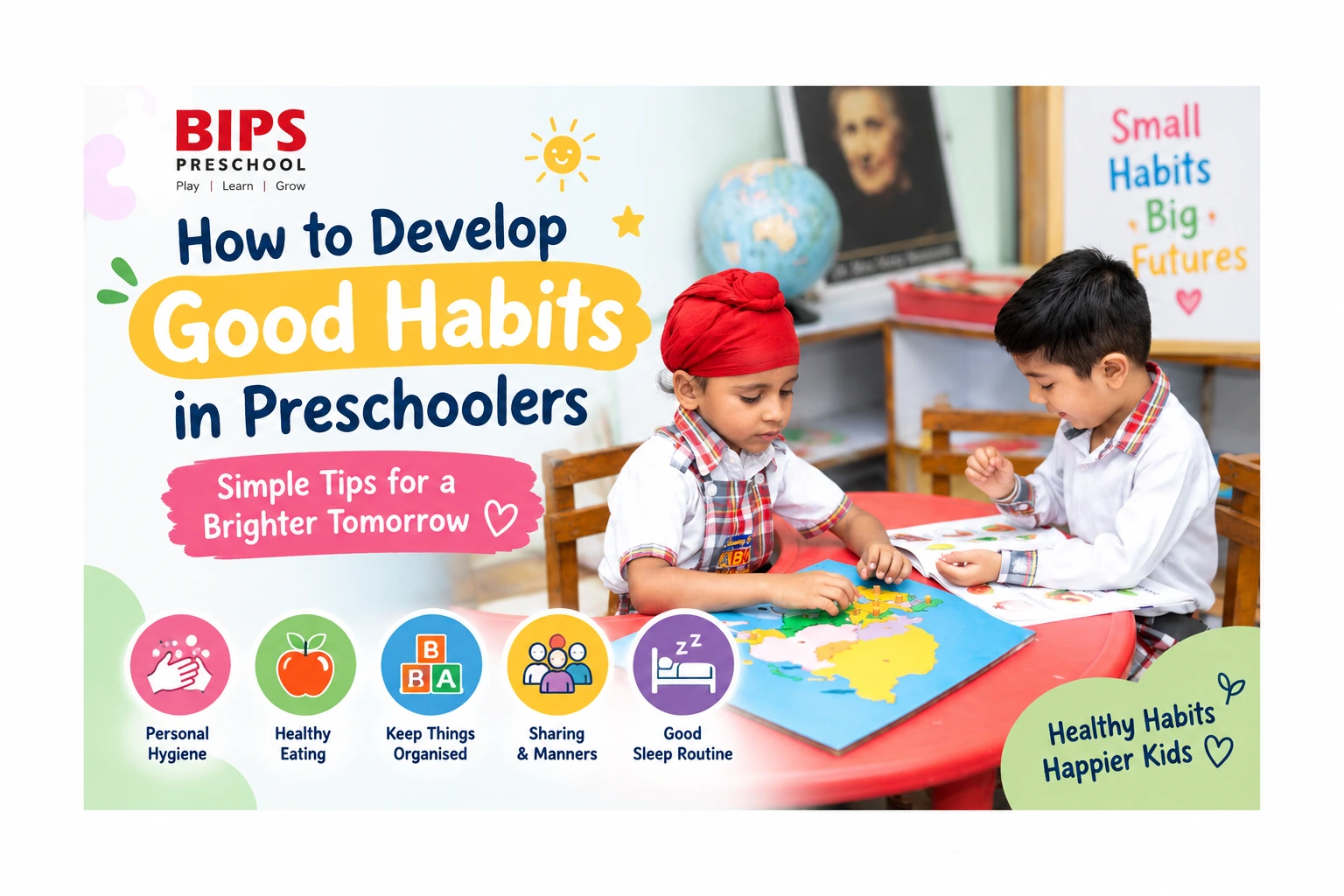
The preschool years are an important time for children to learn new things. During this age, children start becoming more independent and learn how to do many things on their own. It is also the right time to teach them good habits in preschoolers.
Good habits do not develop in one day. Children learn them slowly by watching parents, teachers, and other people around them. Simple daily routines can help children understand what they should do and when they should do it.
At BIPS Preschool, we believe that early childhood education is not only about letters, numbers, and books. It is also about helping children become confident, kind, responsible, and independent.
Here are some simple ways parents can help develop good habits in preschoolers.
1. Start With a Simple Daily Routine
Children feel comfortable when they know what is going to happen next. A simple preschool routine can make everyday activities easier.
Try to keep regular timings for:
- Waking up
- Bathing
- Breakfast
- School
- Playtime
- Lunch
- Homework or learning activities
- Dinner
- Bedtime
A regular routine helps children understand the importance of time and makes them more responsible.
Parents do not need to make the routine complicated. Even a simple morning and bedtime routine can help children develop healthy habits for kids.
2. Teach Personal Hygiene
Personal hygiene is one of the most important habits children should learn at an early age.
Teach your child to:
- Wash hands before eating
- Wash hands after using the toilet
- Brush teeth twice a day
- Take a bath regularly
- Keep nails clean
- Cover their mouth while coughing or sneezing
- Use a tissue or handkerchief when needed
Explain why these habits are important instead of simply telling your child what to do.
For example, you can say, "We wash our hands to keep germs away."
Making hygiene activities fun can encourage children to follow them every day.
3. Teach Children to Keep Their Things in Place
Preschoolers can start learning how to keep their belongings organised.
Teach your child to put toys back after playing, keep shoes in their place, put clothes in the laundry basket, and keep books on a shelf.
You can turn cleaning into a game.
For example, say, "Let's see how quickly we can put all the toys back in their boxes."
This simple activity teaches responsibility, organisation, independence, and discipline.
4. Encourage Healthy Eating Habits
Healthy food habits are important for growing children. Parents should encourage children to eat a variety of nutritious foods.
Include foods such as:
- Fruits
- Vegetables
- Whole grains
- Milk or suitable dairy products
- Pulses
- Eggs or other protein-rich foods
Try to limit excessive sugary snacks and drinks.
Children may not like every healthy food immediately. Instead of forcing them, offer healthy choices regularly and allow them to become familiar with different foods.
Parents can also encourage children to drink enough water during the day.
5. Teach Children to Say "Please" and "Thank You"
Good manners are an important part of social skills for preschoolers.
Teach children simple words such as:
- Please
- Thank you
- Sorry
- Excuse me
- Good morning
- May I?
Children learn by watching adults. When parents use polite words at home, children are more likely to copy them.
Instead of only telling children to be polite, show them what polite behaviour looks like in everyday situations.
6. Teach Sharing and Taking Turns
Preschool children are learning how to play and communicate with other children. They may sometimes find it difficult to share their favourite toy.
Parents and teachers can help children understand the importance of sharing and taking turns.
Use simple sentences such as:
"Your friend can play with it first, and then it will be your turn."
Group games, classroom activities, puzzles, and playtime are excellent ways to develop social development and communication skills.
Children gradually learn that playing together can be more enjoyable than playing alone.
7. Encourage Independence
One of the most useful habits for preschool children is learning to do small tasks independently.
Let your child try simple activities such as:
- Wearing shoes
- Putting on a jacket
- Packing a small bag
- Eating independently
- Keeping toys away
- Choosing clothes
- Carrying their water bottle
It may take longer when children do things themselves, but this is an important part of child development.
Avoid doing everything for your child. Give them enough time to try.
8. Develop a Good Sleep Routine
Sleep is important for a child's growth, learning, mood, and daily energy.
Create a regular bedtime routine for preschoolers. Try to keep bedtime and wake-up times consistent.
A simple bedtime routine could include:
Dinner → Brush teeth → Change clothes → Storytime → Bed
Avoid exciting activities and excessive screen use close to bedtime.
A good sleep routine can help children feel fresh and ready for school the next day.
9. Teach Children to Listen
Listening is an important part of communication and learning.
When you speak to your child, get down to their level and make eye contact. Give short and clear instructions.
Instead of saying:
"Clean everything up right now!"
Try:
"Please put your blocks in the box."
Once the child completes the task, appreciate their effort.
Simple instructions are easier for young children to understand.
10. Encourage Reading Every Day
Reading is a wonderful habit to develop during the preschool years.
Parents can spend 10–15 minutes reading a story with their child every day. Let your child look at the pictures and ask questions.
Reading can support:
- Vocabulary
- Listening skills
- Imagination
- Concentration
- Communication
- Early literacy
You do not need to choose complicated books. Simple picture books and short stories are perfect for preschoolers.
11. Teach Children to Follow Rules
Rules help children understand what is expected from them.
Keep household rules simple and consistent.
For example:
- Toys should be kept away after playing.
- Hands should be washed before meals.
- We speak politely.
- We do not hit others.
- We wait for our turn.
Avoid having too many rules at once. Focus on a few important habits and gradually introduce new ones.
12. Praise Good Behaviour
Positive encouragement can make a big difference.
When your child follows a good habit, tell them that you noticed.
For example:
"Great job putting your toys away!"
"Thank you for sharing with your friend."
"You brushed your teeth without being reminded. Well done!"
Specific praise helps children understand which behaviour they should repeat.
Remember, praise the effort and behaviour, not only the result.
13. Be a Good Role Model
Children learn a lot by watching adults.
If parents want children to develop good habits, they should also practise those habits.
For example, if you want your child to keep things organised, show them how you organise your belongings. If you want your child to speak politely, use polite language at home.
Your actions can teach children more than repeated instructions.
How BIPS Preschool Helps Children Develop Good Habits
At BIPS Preschool, learning goes beyond classroom lessons. A child-friendly environment can give children opportunities to practise communication, independence, cooperation, cleanliness, sharing, creativity, and other important life skills.
Through age-appropriate activities, play-based learning, classroom routines, group activities, and interaction with teachers and other children, preschoolers can gradually develop habits that support their overall growth.
The goal of early education should be to help children become happy, confident, curious, and independent learners.
Final Thoughts
Developing good habits in preschoolers takes patience and consistency. Children will sometimes forget, make mistakes, or need reminders. This is completely normal.
Parents can help by keeping routines simple, showing good behaviour, giving children small responsibilities, and praising positive efforts.
Good habits such as personal hygiene, healthy eating, sharing, listening, reading, cleaning up, sleeping on time, and being polite can become part of a child's daily life when they are taught with patience and love.
With support from parents and teachers, preschool children can build strong habits that help them in school and in everyday life.
At BIPS Preschool, we believe that every small habit learned today can become an important step toward a confident and responsible future.
FAQs
1. What are good habits for preschoolers?
Good habits for preschoolers include brushing teeth, washing hands, eating healthy food, sleeping on time, keeping toys away, sharing, using polite words, listening to adults, and becoming more independent.
2. How can I teach good habits to my preschool child?
Start with one habit at a time. Create a simple daily routine, demonstrate the habit yourself, give gentle reminders, and praise your child's efforts.
3. Why are good habits important for preschoolers?
Good habits help children develop independence, responsibility, confidence, social skills, personal hygiene, and self-discipline. They also prepare children for school and everyday life.
4. How can I make children follow a daily routine?
Keep the routine simple and consistent. Use the same approximate times for important activities such as waking up, meals, playtime, bathing, and bedtime.
5. How do I teach my child to be independent?
Give your child small age-appropriate tasks, such as putting toys away, wearing shoes, choosing clothes, eating independently, or carrying their school bag.
6. How can I teach sharing to a preschooler?
Use playtime and simple games to teach sharing and taking turns. Encourage children to use phrases such as "Your turn" and "My turn."
7. How can parents encourage healthy habits in children?
Parents can encourage healthy habits by offering nutritious foods, encouraging physical activity, maintaining personal hygiene, limiting excessive screen time, and following a regular sleep routine.
8. What is the role of preschool in developing good habits?
Preschool provides children with regular routines and opportunities to practise communication, cooperation, cleanliness, independence, sharing, listening, and other important life skills.
9. How long does it take for a child to develop a habit?
There is no fixed time for every child. Young children may need regular practice and reminders before a habit becomes natural. Patience and consistency are more important than speed.
10. Should parents punish children for forgetting good habits?
Punishment is usually not the best way to teach young children. Gentle reminders, clear expectations, positive reinforcement, and consistent routines can help children learn more effectively.